



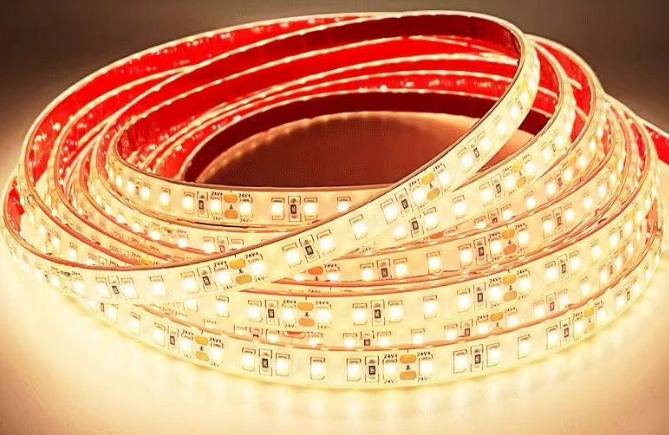
1. What Makes an LED Strip "Underwater-Rated"?
Underwater LED strip lighting is everywhere now — pools, fountains, aquariums, docks. It also fails way more often than it should.
This guide (Part 1) covers selection: how underwater LED strips are made, waterproofing methods, material science, and core specifications — everything you need to choose the right product before you buy.
→ Part 2: Underwater LED Strip Installation Guide — Best Practices, Failure Prevention & Cost Analysis
An underwater LED strip is a flexible LED light designed for continuous submersion in water. This is fundamentally different from "water-resistant" or "splash-proof" strips.
The Three Non-Negotiable Requirements
| Requirement | Standard | Why It Matters |
|---|---|---|
| IP68 rating | IEC 60529, manufacturer-defined depth & duration | Only IP68 covers continuous immersion. IP67 is temporary (1m, 30 min) — it will fail underwater |
| Low voltage (≤24V DC) | NEC 680 / IEC 60364-7-702 | Safety requirement for any lighting near or in water. Mains voltage (110V/220V) must never enter the water |
| Corrosion-resistant encapsulation | Silicone or PU, not PVC | Chlorine, salt, minerals, and UV degrade inferior materials rapidly |
⚠️ Critical distinction: Many suppliers sell "IP68 LED strips" that are actually IP67 strips tested at minimal depth for minimal duration. We'll cover how to tell the difference in Section 3.
2. Why Low Voltage Is Non-Negotiable
Safety First: The Physics
Water and electricity are a dangerous combination. Low-voltage DC power (12V or 24V) is used for underwater LED strips because it eliminates electrocution risk:
| Parameter | 12V DC | 24V DC | 110V/220V AC |
|---|---|---|---|
| Perceived shock | None | Barely perceptible | Dangerous / lethal |
| Body current (wet skin) | ~12 mA | ~24 mA | >100 mA (lethal range) |
| Regulatory acceptance | Universal | Most jurisdictions | Prohibited underwater |
| NEC compliance | ✅ Article 680 | ✅ (verify local code) | ❌ Never for submerged use |
12V vs 24V: Which to Choose?
| Factor | 12V DC | 24V DC |
|---|---|---|
| Safety margin | Highest — universally accepted | High — accepted in most markets |
| Max single-run length | ~5 meters (before visible voltage drop) | ~10–20 meters (depending on wire gauge) |
| Voltage drop rate | ~0.25V/m (standard strip) | ~0.125V/m (standard strip) |
| Power supply options | Widely available | Slightly fewer options |
| Pool/fountain compliance | ✅ Most conservative choice | ✅ Check local code |
| Best for | Aquariums, small water features, strict-code regions | Pools, fountains, long perimeter runs |
Recommendation: For pools and public water features where runs exceed 5 meters, 24V is preferred for its superior voltage drop performance. For aquariums and small installations, 12V offers the safest profile. Always verify local electrical codes — some jurisdictions mandate 12V for submerged pool lighting.
Power Supply Requirements
Underwater installations require:
- Isolating transformer or listed pool power supply (NEC 680.23(A)(2)) — a metal barrier between primary and secondary windings
- GFCI / RCD protection on the supply circuit
- IP67/IP68-rated power supply if located anywhere near the water feature
- Power supply placed above water level — never submerge the driver
3. IP68 Decoded: Why the Same Label Means Different Things
Pay attention to this section — it's where most buyers get burned.
The IP68 Problem
Under IEC 60529, the IP68 rating means "continuous immersion" — but the depth and duration are defined by the manufacturer, not by a fixed standard.
This means two strips can both be legitimately labeled IP68:
| Parameter | Supplier A | Supplier B |
|---|---|---|
| IP Rating | IP68 | IP68 |
| Test depth | 0.5 meters | 2.0 meters |
| Test duration | 1 hour | Continuous (1000+ hours) |
| Water type | Fresh water only | Fresh + salt water |
| Real performance | Survives a brief splash test | Survives years of pool use |
Both are technically "IP68." Both will pass customs. One will fail in 3 months.
What to Ask Your Supplier
When a supplier claims IP68, ask for:
| Question | Why It Matters |
|---|---|
| What depth was the IP68 test conducted at? | 0.5m ≠ 2m. Pools are typically 1.0–1.5m deep |
| What was the test duration? | 1 hour proves nothing for continuous immersion. Look for ≥24h or continuous |
| Was it fresh water or salt water? | Salt water is far more aggressive. Marine applications need salt-water certification |
| Can you provide the third-party test report? | Self-declarations are meaningless. Require SGS, TÜV, UL, or Intertek reports |
| What specific test standard was used? | IEC 60529 is the standard. Anything else is suspect |
How to Read an IP Test Report
A genuine third-party IP test report must include:
| Required Field | What to Look For |
|---|---|
| Laboratory name & accreditation | SGS, TÜV, UL, Intertek, Bureau Veritas |
| Report number | Must be verifiable |
| Test standard reference | IEC 60529 |
| Immersion depth | Specific meter value |
| Immersion duration | Specific time period |
| Water conditions | Fresh / salt / chlorinated |
| Sample preparation method | How the strip was sealed for testing |
| Pass/fail criteria per digit | IP6X + IPX8 separately verified |
Red flag: If the report only says "IP68 tested" with no depth, duration, or lab accreditation number — it's not a real test report.
4. Waterproofing Methods: Potting vs. Silicone Extrusion vs. Solid Silicone
Waterproofing method determines how long your strip actually lasts — not the LED chips, not the PCB. The encapsulation.
Method 1: Potting (Glue Filling )
How it works: The LED strip is placed in a hollow silicone or PVC sleeve, and liquid silicone or polyurethane (PU) is poured in to fill the gaps. After curing, the strip is sealed inside.
| Attribute | Assessment |
|---|---|
| Waterproof level | Can achieve IP68 |
| Cost | Low — simplest manufacturing process |
| Thickness uniformity | ❌ Varies — gravity causes pooling at the bottom |
| Seam integrity | ⚠️ Edges where the sleeve meets the fill are weak points |
| Long-term reliability underwater | ⚠️ Moderate — delamination risk at the PCB-glue interface |
| Best for | Budget projects, temporary installations, above-waterline splash zones |
Failure mode: Over time (6–18 months submerged), the bond between the potting compound and the PCB can delaminate. Water seeps in through microscopic gaps. The strip fails from the inside out — often starting at the cut end or connector point.
Method 2: Silicone Extrusion
How it works: The bare LED strip is fed through a silicone extruder that coats it in a continuous silicone tube. The strip emerges as a flexible, sealed unit.
| Attribute | Assessment |
|---|---|
| Waterproof level | IP68 |
| Cost | Medium — requires extrusion equipment |
| Thickness uniformity | ✅ Consistent wall thickness |
| Seam integrity | ✅ Seamless extrusion — no glued joints |
| Anti-yellowing | ✅ High-grade silicone resists UV |
| Long-term reliability underwater | ✅ Good — 2–5 year lifespan typical |
| Best for | Pool perimeter, fountains, landscape water features |
Advantage over potting: The one-piece construction eliminates the weak interface between potting compound and sleeve. Water has no easy entry path.
Method 3: Solid Silicone Extrusion
How it works: Similar to hollow extrusion, but the LED strip is fully embedded in a solid mass of transparent silicone. There is no hollow space — the silicone IS the strip body.
| Attribute | Assessment |
|---|---|
| Waterproof level | IP68+ (highest practical level) |
| Cost | Highest — more material, precision process |
| Thickness uniformity | ✅ Complete encapsulation |
| Seam integrity | ✅ Zero voids — water cannot penetrate |
| Pressure resistance | ✅ Can withstand greater depths |
| Long-term reliability underwater | ✅ Excellent — 5+ year lifespan achievable |
| Best for | Continuous submersion, pools, marine environments, premium projects |
Why it's the gold standard: There is literally no path for water to reach the PCB. The LED chips, resistors, and copper traces are fully encased in a solid block of waterproof silicone. Even if the outer surface is scratched, the interior remains sealed.
Comparison Summary
| Feature | Potting | Hollow Extrusion | Solid Extrusion |
|---|---|---|---|
| IP Rating | IP67–IP68 | IP68 | IP68+ |
| Cost (relative) | Base | +30–40% | +50–80% |
| Underwater lifespan | 6–18 months | 2–5 years | 5+ years |
| Delamination risk | High | Low | None |
| UV resistance | Moderate | Good | Excellent |
| Flexibility | Moderate | Good | Good |
| Max submersion depth | ~0.5m reliable | ~1.5m reliable | ~2m+ reliable |
| Recommended for | Budget/temporary | Standard projects | Premium/long-term |
5. Material Science: Why Silicone Beats PVC Underwater
The encapsulation material directly determines how long your strip survives underwater. Here's what actually happens to each material.
Silicone vs. PVC vs. PU: Performance Underwater
| Property | Silicone (道康宁/Dow Corning grade) | PVC | PU (Polyurethane) |
|---|---|---|---|
| Transparency (initial) | 92–95% | 88–90% | 90–93% |
| Transparency (after 1 year UV) | 90–93% | 60–75% (yellowing) | 85–88% |
| Chlorine resistance | ✅ Excellent | ❌ Degrades | ⚠️ Moderate |
| Salt water resistance | ✅ Excellent | ❌ Cracks | ⚠️ Moderate |
| Temperature range | -45°C to +200°C | -10°C to +60°C | -30°C to +80°C |
| UV stability | ✅ Excellent (anti-yellowing) | ❌ Poor (rapid yellowing) | ⚠️ Good |
| Flexibility (after 2 years) | ✅ Maintains | ❌ Becomes brittle | ⚠️ Hardens slightly |
| Cost (relative) | High | Low | Medium |
| Typical lifespan underwater | 5+ years | 6–12 months | 2–3 years |
The Chlorine Problem
Pool water contains chlorine (typically 1–3 ppm in residential pools, up to 5 ppm in commercial pools). Chlorine is an aggressive oxidizer that:
- Attacks PVC molecular bonds, causing brittleness and cracking
- Accelerates yellowing, reducing light output by 20–40% within a year
- Corrodes exposed metal contacts at cut ends and connectors
Silicone is inherently chlorine-resistant because its Si-O backbone is chemically inert to halogen compounds. This is why medical-grade and food-grade tubing is made from silicone — it doesn't react.
UV Accelerated Aging: What the Numbers Mean
Reputable manufacturers conduct QUV accelerated aging tests:
| Test Duration | Equivalent Outdoor Exposure | What to Look For |
|---|---|---|
| 300 hours | ~6 months | No visible yellowing |
| 1,000 hours | ~2 years | <5% light transmission loss |
| 3,000 hours | ~5 years | <10% light transmission loss, no cracking |
Ask your supplier for QUV test data. If they can't provide it, they haven't tested it.
6. Core Specifications Explained
Electrical Parameters
Voltage
| Voltage | Max Single-Run (no visible drop) | Best Application |
|---|---|---|
| 12V DC | ~5 meters | Aquariums, small features, strict-code regions |
| 24V DC | ~10–20 meters | Pools, fountains, long perimeter lighting |
| 48V DC | ~40 meters | Large commercial water features |
Power Density
Water conducts heat 24x better than air — so you'd think underwater strips run cool. Problem is, the silicone encapsulation traps that heat against the PCB. Recommended maximum:
| Application | Recommended Max Power | Why |
|---|---|---|
| Pool / fountain (continuous submersion) | ≤10W/m | Heat trapped by silicone, long-term reliability |
| Aquarium | ≤8W/m | Fish sensitivity, lower light needed |
| Marine / dock | ≤10W/m | Salt + heat accelerates aging |
Important: Higher wattage does NOT mean better underwater performance. The silicone encapsulation limits heat dissipation. Running 15W/m or 20W/m strips underwater will dramatically shorten LED life.
LED Chip Selection
| Chip Type | Power per LED | Typical Density | Best Underwater Use |
|---|---|---|---|
| SMD 2835 | 0.2W | 60–120/m | General pool & fountain (cost-effective) |
| SMD 5050 | 0.24W (single), 0.72W (RGB) | 30–60/m | RGB color effects |
| SMD 5733 | 0.5W | 60/m | High-brightness applications |
| COB | N/A (integrated) | N/A | Not recommended for underwater — encapsulation challenges |
Recommendation for pools: SMD 2835 at 60 LEDs/m (12W/m at 24V) offers the best balance of brightness, efficiency, and long-term reliability for underwater use.
PCB (FPCB) Specifications
The flexible PCB is the backbone of the strip. Underwater, it faces constant flex stress from water currents and temperature cycling.
| Parameter | Minimum for Underwater | Premium | Impact |
|---|---|---|---|
| PCB thickness | 0.3mm | 0.4mm | Thicker = more resistant to flex fatigue |
| Copper weight | 1 oz (35μm) | 2 oz (70μm) | Heavier copper = better voltage distribution, less heat |
| Plating | Single-sided | Double-sided | Double-sided dissipates heat 30–50% better |
Double-sided plating is particularly valuable underwater because it distributes current more evenly, reducing hot spots that can degrade the silicone encapsulation over time.
7. Light Behavior Underwater: What Nobody Tells You
Light behaves differently underwater than in air. Understanding this is essential for specifying the right color temperature and brightness.
Water Absorbs Light — Selectively
Water doesn't absorb all wavelengths equally:
| Wavelength / Color | Absorption Rate | Visibility Underwater |
|---|---|---|
| Blue (450–495nm) | Lowest absorption | ✅ Travels furthest |
| Green (495–570nm) | Low absorption | ✅ Travels well |
| Yellow (570–590nm) | Moderate absorption | ⚠️ Moderate distance |
| Orange (590–620nm) | Higher absorption | ⚠️ Shorter range |
| Red (620–750nm) | Highest absorption | ❌ Disappears first |
Practical implication: A warm white 3000K strip will appear significantly dimmer and more yellow-green underwater compared to in air, because the red component is absorbed. Cool white (6000K+) or neutral white (4000K) maintains better perceived brightness underwater.
Light Loss Factors
| Factor | Loss Amount | Notes |
|---|---|---|
| Silicone encapsulation | 5–10% | High-grade silicone minimizes this |
| Water (per 0.5m depth) | 10–20% | Increases with turbidity |
| Angle of incidence | Up to 50% | Strips mounted at angles lose more light to refraction |
| Algae / mineral buildup | 20–60% | Ongoing maintenance issue |
Rule of thumb: Specify 20–30% more lumens than your above-water calculation suggests. A strip that outputs 1000 lm/m in air may only deliver 600–700 lm/m effective light at 1m depth.
Color Strategy for Underwater
| Application | Recommended Color | Why |
|---|---|---|
| Swimming pool (general) | Cool white 6000–6500K | Maximum visibility, clean water appearance |
| Pool (ambiance) | RGB or RGBW | Dynamic effects for evening atmosphere |
| Fountain / water feature | RGBW with DMX control | Programmable shows, white for daytime |
| Aquarium | High CRI (≥90) 5000–6500K | Accurate fish/plant color rendering |
| Marine / dock | Warm white 3000K or amber | Reduces light pollution, marine-life friendly |
What's Next?
You've learned how to select the right underwater LED strip — waterproofing methods, materials, and specifications. But selection is only half the equation.
→ Read Part 2: Underwater LED Strip Installation Guide — Best Practices, Failure Prevention & Cost Analysis
About Us
We are a specialized LED strip manufacturer with 17 years of experience serving distributors, importers, and project contractors across 40+ countries. Our underwater LED strip product line includes solid silicone extrusion IP68 strips rated for continuous submersion in pools, fountains, and marine environments.
All our underwater products come with third-party IP68 test reports (SGS / Intertek), QUV aging data, and optional chlorine resistance certification. We provide free samples for underwater testing and technical consultation for project-specific waterproofing specifications.