



1. Six Application Scenarios
In Part 1, we covered how to select the right underwater LED strip — IP68 decoding, waterproofing methods, materials, and core specifications.
This guide (Part 2) covers what happens after you buy: six real-world application scenarios, installation best practices, the most common failure modes and how to prevent them, a supplier evaluation checklist, and a 5-year cost comparison.
Scenario 1: Swimming Pool Perimeter Lighting
Challenge: Continuous submersion in chlorinated water, potential chemical imbalance, UV exposure at the waterline.
| Specification | Recommendation |
|---|---|
| Waterproofing | Solid silicone extrusion (IP68+) |
| Voltage | 24V DC |
| Power density | ≤10W/m |
| Color | Cool white 6000K or RGBW |
| LED chip | SMD 2835, 60 LEDs/m |
| Connector type | Injection-molded waterproof connector |
| Power supply | IP67 rated, GFCI protected, mounted above water |
| Expected lifespan | 5+ years |
Installation note: Mount the strip in a pre-installed PVC or stainless steel channel below the waterline. Adhesive doesn't last in chlorinated water — even the "underwater-rated" stuff. Secure with stainless steel clips at 30cm intervals.
Scenario 2: Fountain & Water Feature
Challenge: Dynamic water movement, spray exposure, DMX control requirements for light shows.
| Specification | Recommendation |
|---|---|
| Waterproofing | Solid silicone extrusion or hollow extrusion (IP68) |
| Voltage | 24V DC |
| Control | DMX512 controller with waterproof enclosure |
| Color | RGB or RGBW |
| Connector | IP68-rated screw-lock connectors |
| Special consideration | Seal ALL connection points with marine-grade silicone |
Scenario 3: Aquarium & Fish Tank
Challenge: Biological sensitivity — materials must not leach chemicals. Fish can be stressed by incorrect color temperature.
| Specification | Recommendation |
|---|---|
| Waterproofing | Solid silicone extrusion (prevents any leaching) |
| Voltage | 12V DC (safest for indoor tank proximity) |
| Power density | ≤8W/m (fish don't need high brightness) |
| Color | High CRI (≥90), 5000–6500K for freshwater; 10,000K+ for reef tanks |
| Special consideration | Verify RoHS compliance — copper and lead must be fully encapsulated |
Scenario 4: Marine & Dock Lighting
Challenge: Saltwater corrosion, wave action, UV exposure, wide temperature swings.
| Specification | Recommendation |
|---|---|
| Waterproofing | Solid silicone extrusion only (IP68+) |
| Voltage | 24V DC |
| Hardware | 316 stainless steel clips and mounting hardware |
| Material | Must specify salt-water tested silicone |
| Special consideration | Salt spray test (IEC 60068-2-11) certification recommended |
Scenario 5: Landscape Pond & Lake
Challenge: Long cable runs, organic growth (algae), potential solar/battery hybrid power.
| Specification | Recommendation |
|---|---|
| Waterproofing | Hollow or solid silicone extrusion |
| Voltage | 24V DC (for longer runs) |
| Power supply | Solar + battery hybrid or low-voltage landscape transformer |
| Special consideration | Voltage drop on long cable runs — plan power injection points |
Scenario 6: Commercial Water Installation (Hotels, Malls)
Challenge: High visibility, client expectations, complex shapes, maintenance access.
| Specification | Recommendation |
|---|---|
| Waterproofing | Solid silicone extrusion (premium) or silicone Neon Flex (underwater-rated) |
| Voltage | 24V DC |
| Control | DMX512 or DALI for integration with building management |
| Special consideration | Mock-up testing before full installation; spare strips for quick replacement |
2. Installation Best Practices
Mounting Methods (Ranked by Reliability)
| Method | Reliability Underwater | Notes |
|---|---|---|
| Pre-installed mounting channel | ⭐⭐⭐⭐⭐ | Best method — PVC or stainless channel cast into pool wall |
| Stainless steel clips (316 grade) | ⭐⭐⭐⭐ | Secure, removable, corrosion-resistant |
| Silicone adhesive | ⭐⭐⭐ | Works initially, degrades in chlorinated water over 1–2 years |
| 3M VHB tape | ⭐ | ❌ Do NOT use underwater — adhesive dissolves in water |
| Tie wraps (nylon) | ⭐⭐ | Temporary only — UV degrades nylon, water pressure can loosen |
The Weakest Link: Connections and End Caps
The strip body is usually well-sealed. 90% of underwater failures happen at connection points.
| Connection Type | Reliability | Recommendation |
|---|---|---|
| Injection-molded connector | ⭐⭐⭐⭐⭐ | Factory-sealed, best option |
| Screw-lock waterproof connector | ⭐⭐⭐⭐ | Field-installable, good seal |
| Heat-shrink + silicone sealant | ⭐⭐⭐ | Acceptable if done carefully, inspect annually |
| Solder + tape | ⭐ | ❌ Will fail underwater — guaranteed |
End cap treatment: Every cut end must be sealed with:
- Silicone end cap (factory or field-applied)
- Marine-grade silicone sealant over the cap
- Heat-shrink tubing over the sealant (optional, for extra protection)
Power Supply Placement
| Rule | Why |
|---|---|
| Power supply above water level | Prevents submersion risk during flooding |
| At least 1.5m horizontal distance from pool edge | Code requirement in most jurisdictions |
| In a ventilated, weatherproof enclosure | Prevents moisture ingress and overheating |
| GFCI / RCD on the supply circuit | Life safety — mandatory |
| Isolating transformer (NEC 680 compliant) | Prevents ground fault propagation |
Wiring Conduit
For underwater cable routing:
- Use rigid conduit (RMC, IMC, or Schedule 80 PVC) per NEC 680.25
- Seal all conduit entry points with waterproof fittings
- Never run cable through water without conduit protection
3. Common Failure Modes and How to Prevent Them
| Failure | Root Cause | Prevention |
|---|---|---|
| Dead LEDs after 3–6 months | Potting method, edge delamination | Specify solid silicone extrusion |
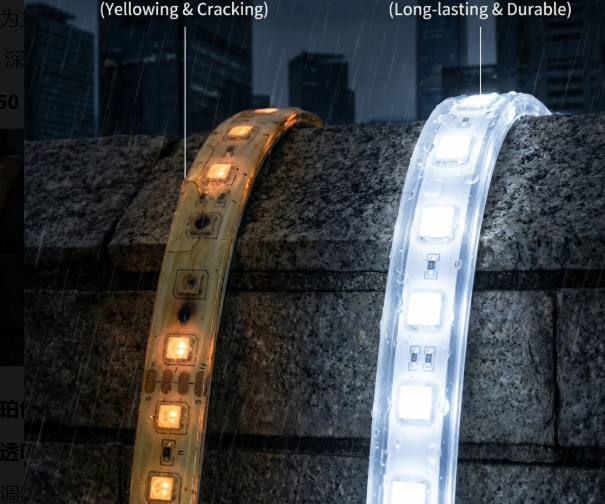
| Yellowing and dimming | PVC material, UV degradation | Specify anti-UV silicone |
| Short circuit at connector | Seal failure at connection point | Use injection-molded connectors |
| Brightness fade at strip ends | Voltage drop over long runs | Use 24V, shorten runs, or add power injection |
| Color shift (appears green) | Red wavelength absorbed by water | Pre-compensate with warmer source or higher CRI |
| Strip detaches from surface | Adhesive failure in water | Use mechanical mounting (channel or clips), never adhesive |
| Complete failure after pool shock | Chlorine concentration spike degrades PVC | Silicone encapsulation is chlorine-resistant |
| Water inside the strip | Cut end not properly sealed | Factory-sealed ends or field-seal with silicone + heat shrink |
The 80/20 of Underwater Failures
80% of underwater LED strip failures come from two causes:
- Wrong encapsulation method — using potted strips or PVC-sleeved strips for continuous submersion
- Unsealed connection points — cut ends, splices, or connectors without proper waterproofing
Solve these two, and you eliminate the majority of field failures.
4. Supplier Evaluation Checklist
5 Questions to Ask Before Ordering
| # | Question | Acceptable Answer | Red Flag |
|---|---|---|---|
| 1 | What waterproofing method do you use for IP68 strips? | Solid silicone extrusion or hollow extrusion | "Glue filling" or "potting" for underwater use |
| 2 | Can you provide third-party IP68 test reports? | Yes, from SGS/TÜV/UL/Intertek, with depth & duration | "We test ourselves" or no report available |
| 3 | What encapsulation material? | Silicone (Dow Corning or equivalent grade) | PVC or unspecified |
| 4 | Do you have QUV aging test data? | Yes, 1000h+ with <5% transmission loss | No data or "not tested yet" |
| 5 | How are connection points sealed? | Injection-molded or factory-sealed | "Customer seals on site" with no guidance |
Sample Testing Protocol
Before committing to a bulk order, test samples with this protocol:
| Test | Method | Pass Criteria |
|---|---|---|
| Submersion test | Submerge in water at target depth for 72 hours | No moisture ingress, all LEDs functional |
| Bend test | Bend around 30mm radius, 10 cycles | No cracking, no LED failure |
| Chlorine test (pool applications) | Submerge in 5ppm chlorine solution for 168 hours (1 week) | No discoloration, no seal degradation |
| Salt spray test (marine) | Per IEC 60068-2-11, 48 hours | No corrosion, no seal failure |
| Thermal cycling | -10°C to +60°C, 10 cycles, submerged | No delamination, no LED failure |
5. Total Cost of Ownership: Why Cheap Strips Cost More
The Real Cost Comparison
| Factor | Budget (Potted PVC) | Standard (Extruded Silicone) | Premium (Solid Silicone) |
|---|---|---|---|
| Unit price (per meter) | $1.50–2.50 | $3.00–5.00 | $5.00–8.00 |
| Expected underwater lifespan | 6–18 months | 2–5 years | 5+ years |
| Replacement cycles (5 years) | 3–8x | 1–2x | 0–1x |
| Replacement material cost | $4.50–20.00/m | $3.00–10.00/m | $0–8.00/m |
| Labor per replacement | $5–15/m | $5–15/m | $0 (no replacement) |
| 5-year total cost | $25–55/m | $15–30/m | $5–8/m |
Buy cheap, pay twice — that's the pattern with underwater strips.
And the table above doesn't even count the indirect costs: project delay penalties from failed installations, lost client trust, the $200–500+ you spend draining and refilling a pool each time a strip dies, and the water chemistry rebalancing that follows.
The Decision Framework
| If your project... | Choose... |
|---|---|
| Is temporary (event, exhibition, <1 year) | Potted IP68 — acceptable for short-term |
| Is a standard pool or fountain (3–5 year expectation) | Hollow silicone extrusion — good value |
| Is premium, commercial, or hard-to-access | Solid silicone extrusion — invest once, no callbacks |
| Is marine or saltwater | Solid silicone extrusion — only reliable option |
FAQ
Can I use a standard IP67 strip underwater?
No. IP67 is rated for temporary immersion (1m, 30 minutes). It will fail under continuous submersion. Always use IP68 for underwater applications.
Can I cut an underwater LED strip to length?
Yes, but every cut end must be resealed immediately with silicone end caps and marine-grade sealant. An unsealed cut end is the fastest path to failure.
Do I need a special power supply for underwater strips?
Yes. You need an isolating transformer or listed pool power supply with GFCI/RCD protection. The power supply must be mounted above water level. Never use a standard indoor power supply near water.
How deep can IP68 strips go?
It depends on the manufacturer's test specification. Standard IP68 strips are typically rated for 0.5–1.5m. For deeper applications, request specific depth-rated products and verify with test reports.
Can I use RGB strips underwater?
Yes, but ensure the RGB strip uses silicone extrusion (not PVC sleeve). RGB strips have more internal connections (3 or 4 channels), making connection sealing even more critical.
Will chlorine damage the strip?
PVC-encapsulated strips will degrade rapidly in chlorinated water. Silicone-encapsulated strips are inherently chlorine-resistant. Always specify silicone for pool applications.
How do I control color-changing strips in a pool?
Use a DMX512 or RF controller in a waterproof enclosure positioned above water level. The controller must never be submerged. Use waterproof screw-lock connectors between the controller and the strip.
Get in Touch
Planning an underwater lighting project?
- Request free samples — Test IP68 performance in your actual water conditions before committing to bulk
- Download underwater strip spec sheet — Complete technical data including IP68 test conditions, QUV aging data, and installation guidelines
- Technical consultation — We help specify the right strip, power supply, and installation method for your specific project
- Custom specifications — Custom lengths, colors, connector types, and private labeling available
Contact Us → | Request Samples → | Download Underwater Strip Spec Sheet →
Sources & Further Reading
- IP68 Underwater LED Strip — LEDSuntech — Comparison of potting vs. silicone extrusion manufacturing processes
- Underwater LED Strip for Fountains & Water Features — ColorsLED — Application guide for fountain and water feature installations
- IP68 Silicone Extrusion LED Strips — SunroLEDs — One-piece silicone extrusion construction details
- Waterproofing Processes in LED Strip Lights — SignLiteLED — Detailed manufacturing process explanation (extrusion and potting)
- Best Guide: IP67/IP68 Waterproof LED Strip Lights — Derun LED — IP rating comparison and selection guide
- LED Strip Lights for Swimming Pool — LEDYi — Pool installation guide with IP rating and safety considerations
- IP68 LED Strip Installation Underwater — DIY StackExchange — Community discussion on installation methods and materials
- Light Up Your Nights — Pool LED Strip Installation Guide — PaneraLux — Comprehensive pool strip installation walkthrough
- Pool Rated IP68 Neon RGB Strip — AQ Lighting — IP68 submersion specifications (1.5m rated)
- LED Strip Factory Tour: Silicone Neon Extrusion Process — YouTube — Factory video showing the silicone extrusion production process
- IP68 Silicone Neon Flex for Pool Lighting — YouTube — Product showcase of IP68 silicone neon flex for pool environments