



Table of Contents
- Same Dress, Different Store, Different Color
- Ra and R9 Explained in Plain English
- What We Tested
- The Numbers: Ra80 vs Ra90 Side by Side
- R9=0 vs R9=60: What Your Eyes Actually See
- The Catch: Ra90 Is Dimmer (And How to Fix It)
- Which Projects Need Ra90?
1. Same Dress, Different Store, Different Color
You've probably had this experience: a piece of clothing looks amazing under the store lights. You take it home, and somehow it looks... flat. The color isn't as rich. The fabric doesn't pop.
It's not the clothing. It's the light.
That's what CRI (Color Rendering Index, or Ra) is all about. A light source with high Ra makes colors look the way they're supposed to look. Low Ra makes everything slightly washed out.
Most LED strip buyers know to check Ra. They see "Ra80" on the spec sheet and think "that's good enough." Or they see "Ra90" and wonder if the premium is worth it.
We decided to stop guessing and start measuring.
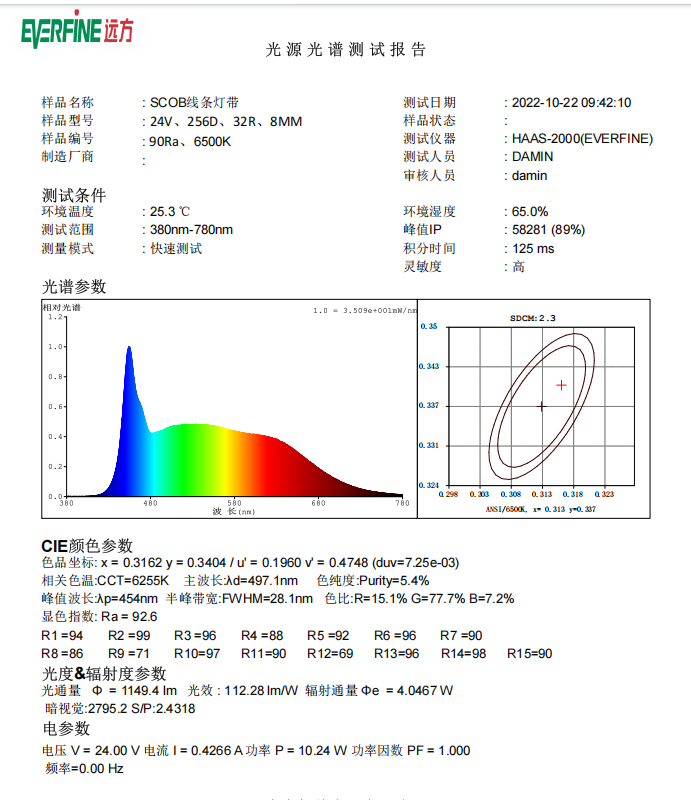
We took two COB LED strip series — one Ra80, one Ra90 — built on the exact same hardware platform, and ran them through a spectrometer. Same voltage, same LED density, same PCB. The only difference is the phosphor (the chemical layer that creates the white light).
Here's what we found.
2. CRI Explained: What is the Difference Between Ra and R9?
Before we get to the data, two things you need to know:
Ra (CRI) measures how natural colors look under the light, on a scale of 0–100. Higher is better. Ra80 means colors look "okay." Ra90 means colors look "accurate."
R9 is the one number most buyers never check — and it's the one that matters most. R9 measures how well the light renders red. And red is everywhere: skin tones, wood, food, fabrics, cosmetics.
Here's the catch: Ra does NOT include R9. Ra is calculated from R1 through R8 (muted, pastel colors). The saturated colors — red, yellow, green, blue — are measured separately.
So two strips can both be labeled "Ra80," but one might have R9=20 (renders red okay) and the other R9=0 (can't render red at all).
When you buy LED strips, always check two numbers: Ra AND R9.
3. What We Tested
Both series share the same platform:
- Type: COB (Chip on Board) LED strip
- Voltage: 24V DC
- LED density: 256 LEDs/m
- PCB width: 8mm
- Test instrument: EVERFINE HAAS-2000 spectrometer
- Conditions: 25.3°C, 65% humidity
We tested at five matching color temperatures: 2700K, 3000K, 3500K, 4000K, and 6500K — so every comparison is apples to apples.
4. The Numbers: Ra80 vs Ra90 Side by Side
Instead of showing you 40 rows of data, here's the comparison at the two color temperatures that matter most: 3000K (the go-to for hotels and restaurants) and 2700K (the favorite for luxury homes).
At 3000K (Warm White)
| Ra80 Strip | Ra90 Strip | |
|---|---|---|
| Ra | 81.3 | 90.9 |
| R9 (red) | 2 | 51 |
| R15 (skin tone) | 72 | 87 |
| Brightness | 1303 lm | 1128 lm |
| Efficacy | 125.7 lm/W | 109.8 lm/W |
Ra90 renders red 25x better (R9: 2 → 51). Skin tones look natural instead of flat. But you lose about 13% brightness.
At 2700K (Ultra Warm)
| Ra80 Strip | Ra90 Strip | |
|---|---|---|
| Ra | 80.3 | 93.3 |
| R9 (red) | 0 | 61 |
| R15 (skin tone) | 70 | 89 |
| Brightness | 1181 lm | 953 lm |
| Efficacy | 114.2 lm/W | 91.5 lm/W |
This is the starkest contrast. Ra80 at 2700K scores R9=0 — it literally cannot render red. Zero. Ra90 scores 61. That's the difference between "meh" and "wow" in a luxury bedroom or hotel suite.
Brightness drops about 19% — more noticeable, but still fixable (we'll cover that below).
Quick Summary Across All Color Temperatures
| Color Temp | Ra80 → Ra90 | R9 Improvement | Brightness Loss |
|---|---|---|---|
| 2700K | 80 → 93 | 0 → 61 | -19% |
| 3000K | 81 → 91 | 2 → 51 | -13% |
| 3500K | 83 → 93 | 7 → 63 | -16% |
| 4000K | 83 → 96 | 8 → 82 | -19% |
| 6500K | 84 → 93 | 10 → 71 | -14% |
Every single color temperature shows the same pattern: Ra90 gives you massively better color rendering, especially in the red spectrum, at the cost of 10-20% brightness.
5. R9=0 vs R9=60: What Your Eyes Actually See
Numbers are abstract. Here's what R9 actually means in real spaces:
Under R9=0 light (Ra80 at 2700K):
- Your client's skin looks pale and grayish — not the warm, healthy tone they expect
- The mahogany reception desk looks flat and yellowish — no depth, no grain
- That red dress in the display? Looks brownish-orange
- The steak on the restaurant plate? Looks gray, not appetizing
- Makeup color matching in the beauty salon? Way off
Under R9=60 light (Ra90 at 2700K):
- Skin looks warm and natural — the way it looks in daylight
- Wood grain has depth and richness — you can see the texture
- Reds are true and vibrant — fabrics pop
- Food looks fresh and appealing
- Makeup shades are accurate — what the client sees is what they get
This is why high-end hotels, restaurants, and retail stores insist on Ra90. It's not a spec sheet exercise — it's something their customers feel immediately, even if they can't explain why.
Simple rule: If people will be looking at colors in the space — people, food, products, art — you need R9>30 minimum. R9>50 is recommended. R9>60 is premium.
6. High CRI vs Lumens: Why is Ra90 Dimmer and How to Fix It?
There's no free lunch. Better color rendering costs brightness. Here's why:
LED chips emit blue light. A phosphor layer converts that blue into white. To get higher CRI, you need more red phosphor. Red phosphor is less efficient than green/yellow phosphor. So more red = better colors, but fewer total lumens.
Across our test data, Ra90 strips are about 15-17% dimmer than Ra80 strips on average.
Is that a problem? Usually no. Here's how to compensate:
- Use higher LED density: If Ra80 is 256 LEDs/m, go 320 or 384 LEDs/m for Ra90
- Use slightly higher power: Bump from 10W/m to 12-15W/m
- Add 10-20% more strip length in your layout
Plan for it during the design phase and it's a non-issue.
The real question is: Will your client notice 15% less brightness? Probably not. Will they notice colors that look flat and wrong? Absolutely.
7. Which Projects Need Ra90?
Ra80 Is Fine For:
- Warehouses and factories — nobody is judging color accuracy
- Parking garages — functional lighting only
- Stairwells and corridors — people are passing through
- Budget residential — if the client isn't particular about light quality
- Backlighting — indirect use where color rendering isn't critical
Spend the Extra on Ra90 For:
Hotels and hospitality — guests pay for the experience. Warm, flattering light in rooms and lobbies directly impacts their impression. (R9>50)
Restaurants and bars — food has to look appetizing. A steak under R9=0 light looks gray. Under R9>50 it looks delicious. (R9>50)
High-end retail and display cases — your client is selling products based on how they look. If the light doesn't render colors accurately, they're losing sales. (R9>60)
Luxury residential — walk-in closets, bathrooms, living rooms. Skin tones, wood, fabrics — everything needs to look right. (R9>50)
Art galleries and museums — non-negotiable. Artwork must be rendered faithfully. (R9>50, Ra>90)
Beauty salons and spas — color accuracy is literally the service they're selling. Wrong light = wrong makeup shade. (R9>50)
The simple test: Ask yourself — "Will someone in this space be looking at colors?" If yes, go Ra90. If the space is purely functional, Ra80 saves money without anyone noticing.
About CNstrip
Cn strip (est. 2008) is an LED strip and power supply manufacturer based in Jiangmen,Guangdong, China. We offer both Ra80 and Ra90 COB LED strips across a full range of color temperatures — and we provide spectrometer test reports for every batch.
All our COB LED strips feature:
- ✅ Full range of CCT options (2700K–6500K)
- ✅ Ra80 and Ra90 options available
- ✅ Spectrometer test reports with R1–R15 data
- ✅ SDCM<3 color consistency
- ✅ Third-party tested (CE, RoHS)
Not sure whether Ra80 or Ra90 is right for your project?
📩 Contact us at [email protected] or DM us on LinkedIn with your project details — we'll send you real test data and help you pick the right spec.